Physical Therapy Services
Kinesio Taping
Supportive rehabilitative taping for muscles and joints.
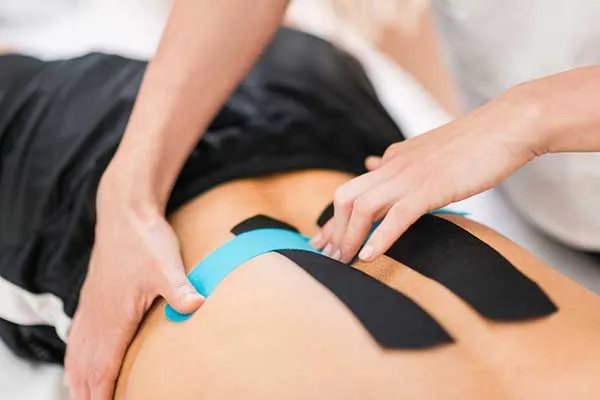
Kinesio Taping
Kinesiology taping is a precise rehabilitative taping technique designed to facilitate the body's natural healing process while providing support and stability to muscles and joints. It allows a normal range of motion while providing extended soft tissue support. Kinesio tape is latex-free and hypoallergenic, which makes it skin friendly for patients with sensitive or fragile skin, such as those with diabetes, fibromyalgia, or rheumatoid arthritis.
How This Works
How kinesio taping care works at Omega Physical Therapy
Kinesiology tape is a thin, elastic cotton strip with an acrylic adhesive. It is applied along a muscle or around a joint in a particular direction and at a particular tension, chosen for what the therapist is trying to do in that spot — give a working muscle some support, or lift the skin very slightly over an area that is swollen or tender. Because the tape stretches with you, it does not lock a joint down the way a rigid athletic strapping does, which is why it can be worn while you carry on with normal activity.
At Omega Physical Therapy taping is applied by Dr. Dmitry Shestakovsky, DPT as one part of a wider plan rather than as a treatment on its own. He assesses the area first, decides whether taping suits what he finds, and then applies it in the pattern that matches the assessment. Kinesio tape is latex-free and hypoallergenic, so it is commonly used on skin that is sensitive or fragile. An application is generally left in place for a few days at a time, showers included, and is peeled off slowly rather than pulled.
What to Expect
One-on-One Care, Built Around You
Taping is decided at the table, after the assessment — so a first visit looks the same whether or not you end up leaving with tape on.
Evaluation
A one-on-one evaluation with Dr. Shestakovsky: your history, what aggravates the area, and a look at how the joint and the surrounding muscles move and load. That is what determines whether taping is appropriate at all, and if so, where and in which direction.
Hands-on treatment
Treatment for the underlying problem comes first — manual and soft-tissue work, and therapeutic rehabilitation as indicated. Tape is then applied over skin that has been prepared, in the pattern the assessment called for.
Your home program
You are shown how to look after the tape between visits: what it should feel like, how long to leave it on, how to remove it, and what to do if the skin becomes irritated. Any exercises you have been given go alongside it.
Follow-up and review
At the next visit the response is reviewed and the application is changed, repeated or dropped. Taping is not meant to be permanent — it is used while it is useful.
Benefits
What kinesio taping care is used for
Physical therapy is individualized, and what any plan involves depends on your evaluation. These are the situations this kind of care is commonly used to address at our Brooklyn office.
- Providing extended soft-tissue support to muscles and joints while still allowing a normal range of motion
- Supporting an area during everyday activity or sport between treatment sessions
- Situations where a rigid strapping would restrict movement more than is wanted
- Patients with sensitive or fragile skin, since the tape is latex-free and hypoallergenic
Common Questions
Kinesio Taping FAQs
Does kinesio taping hurt?
The application itself is not a painful procedure — the tape is laid onto the skin, not pulled tight against it. Some people find the adhesive itchy, and removing tape from hairy skin can be uncomfortable, which is why it is peeled off slowly. Tell Dr. Shestakovsky if the skin under the tape starts to sting, burn or redden, and take it off.
How long does the tape stay on?
An application is generally worn for a few days at a time rather than a few hours, and it is water-resistant enough to shower in. How many applications you have depends on how the area responds, which is reviewed at each visit.
Can I get taped without having an evaluation first?
No. Taping at Omega Physical Therapy is applied as part of a treatment plan, and where the tape goes is decided by what the evaluation finds. The first appointment is always an assessment with Dr. Shestakovsky.
What should I wear?
Loose, comfortable clothing that lets the area being treated be reached — a t-shirt and shorts or leggings work for most appointments. If you are being taped, it helps to leave that skin free of lotion or oil that day.
Is it covered by my insurance?
Omega Physical Therapy welcomes insurance and will do everything it can to help you receive as many benefits from your plan as possible. Because there are so many different plans and coverage options, the office cannot give a definite answer in advance — a copy of your insurance card is taken at your appointment so your coverage can be estimated. Cash, checks, debit cards and most major credit cards are also accepted. Call (718) 996-9929 with your plan details and the front desk will talk it through with you.
Have a question that is not here? Call (718) 996-9929 and we will answer it.
Explore More